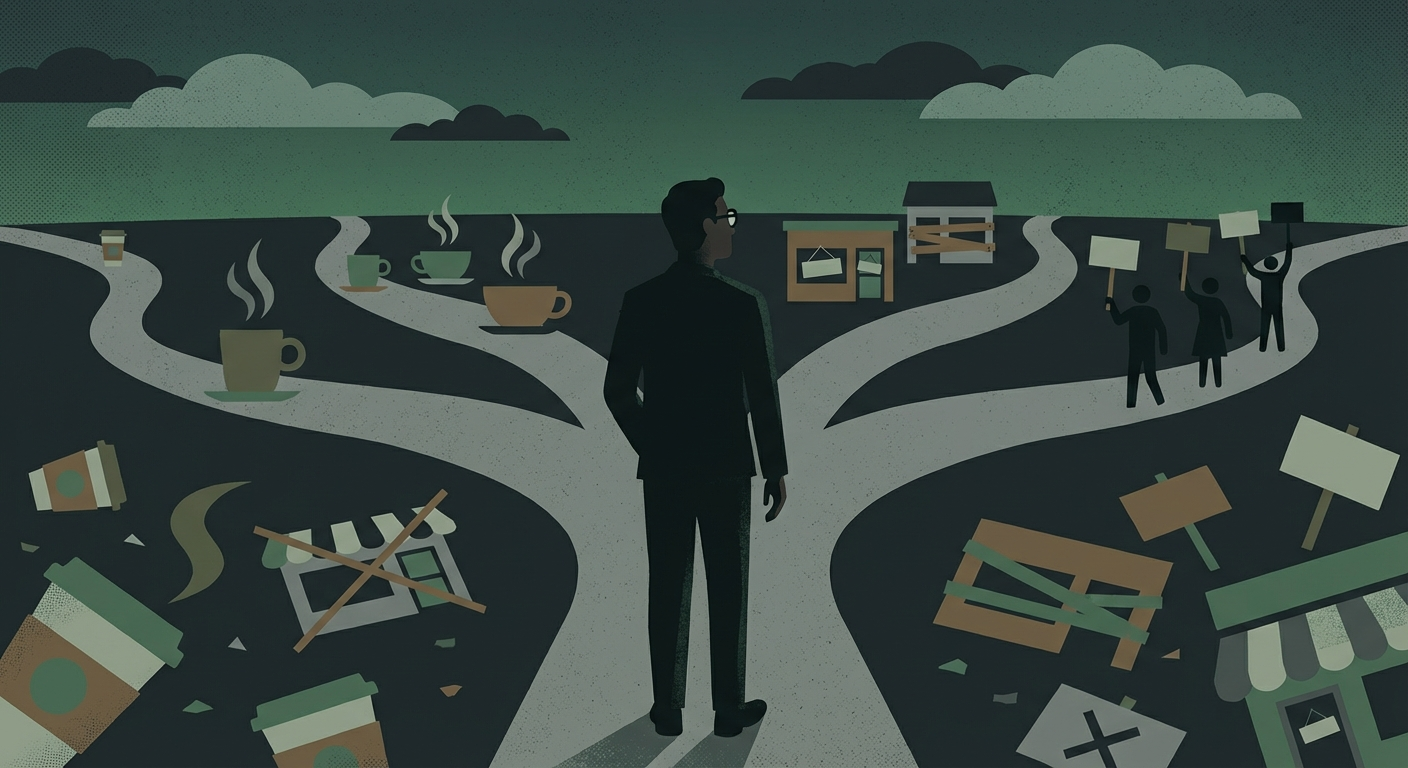
3 CEO Returns: Howard Schultz Closed 600 Stores and Saved Starbucks
Howard Schultz didn’t ‘lead Starbucks for decades’—he rebooted it three separate times. Each return used the same move: protect the brand’s core even if the optics look brutal.
TL;DR
- Starbucks didn’t have one Howard Schultz era. It had three: builder (1986–2000), rescuer (2008–2017), and interim firefighter (2022–2023). ✓ (Source)
- The 2008 turnaround wasn’t “inspiration.” It was operational violence: 600 store closures, layoffs, and a one-day shutdown of 7,100 U.S. stores to retrain baristas. ✓ (Source)
- Schultz’s playbook: protect the “third place” identity first, then rebuild growth—often by removing what growth added (complexity, speed-at-all-costs, diluted culture). ⚡
- The dark truth: repeated founder returns can signal a company that never built a self-sustaining operating system beyond the founder. ⚡
Hook + Background
If you want the clean story, Starbucks is easy: premium coffee, great vibes, unstoppable growth.
If you want the true story, it’s uglier—and more useful.
Starbucks is a case study in founder dependency disguised as brand magic. Howard Schultz didn’t “run Starbucks for 30 years.” He left, watched it drift, then came back—twice—to yank it back to center.
Here’s the timeline you actually need:
- First stint (builder): Schultz bought Starbucks in 1987 for $3.8M, took it public in 1992, and scaled it to 3,000+ stores by 2000. ✓ (Source)
- Second stint (turnaround CEO): He returned as CEO in January 2008 after the stock had fallen about 75% from 2006–2008, then closed stores, cut costs, retrained staff, and rebuilt the core experience. ✓ (Source)
- Third stint (interim crisis manager): He returned in April 2022 as interim CEO during a unionization wave and broader operational/brand strain. ✓ (Source)
This article isn’t about “leadership.” It’s about decisions: what Schultz did when Starbucks started behaving like a fast-food chain wearing a premium costume.
Core Decision Analysis
Decision 1: Don’t franchise—own the culture, not just the logo
Schultz resisted a growth cheat code: franchising.
- Starbucks’ U.S. stores were primarily company-operated, and Schultz historically pushed against franchising to maintain consistency and culture. ✓ (Source)
⚡ If your product is a ritual, your real asset is behavioral consistency (service, smell, music, cadence). Franchising turns that into a contract dispute.
💬 Most CEOs treat franchising as “asset-light strategy.” Schultz treated it as identity dilution.
Decision 2 (2008): Admit the brand got worse—then do the embarrassing fix in public
In the mid-2000s, Starbucks expanded hard. And the thing that made it premium—craft, cadence, human rhythm—started collapsing under operational load.
Schultz’s 2008 return wasn’t a single move. It was a sequence of humiliations designed to re-center quality:
- He returned as CEO on Jan 8, 2008. ✓ (Source)
- Starbucks closed 600 stores in 2008, and later another 300 in 2009, alongside major layoffs. ✓ (Source)
- Starbucks shut all ~7,100 U.S. stores for a day for barista retraining (reported immediate cost around $6M). ✓ (Source)
- The turnaround included roughly $850M in cost savings and thousands of job cuts. ✓ (Source)
⚡ The unpopular truth: when the product is the experience, “don’t disrupt the customer” is sometimes the wrong rule. You must disrupt the customer once to stop disappointing them forever.
💬 A one-day shutdown is a CEO saying: “We’d rather lose one day of revenue than keep selling a lie.” That’s rare. And yes, it’s also a PR grenade.
Decision 3 (2008–2010): Rebuild the feedback loop—not just the P&L
Cutting stores and retraining fixes the surface. But Starbucks also rebuilt how it listens and adapts.
- Starbucks launched My Starbucks Idea (2008), a crowdsourcing platform that accumulated 93,000+ ideas from 1.3M users, implementing 100+. ✓ (Source)
⚡ Turnarounds fail when the company’s sensors are broken. Bad news arrives too late, filtered by incentives.
💬 “Listening” is usually corporate theater. But the metric here (ideas submitted, ideas shipped) suggests Starbucks treated it like a product backlog.
Decision 4 (2009): Build the mobile engine—then get punished by your own success
Starbucks didn’t just retrain baristas. It also laid the rails for modern consumer habit loops.
- Starbucks launched its mobile app in 2009. ✓ (Source)
- Mobile ordering later grew to roughly one-third of orders (often cited around 33%). ✓ (Source)
⚡ Mobile order is operational leverage. It prints demand.
💬 It also shreds the “third place.” When a cafe becomes a fulfillment center, you can hit the numbers while quietly killing the reason people loved you.
Decision 5 (the structural one): Founder returns as a strategy—until it becomes a symptom
The uncomfortable pattern:
- Schultz stepped down as CEO in 2000 and later returned in 2008, then returned again as interim CEO in 2022. ✓ (Source)
⚡ A founder return can be the best emergency tool in business.
⚡ It can also be the clearest proof that the company never encoded the founder’s judgment into systems: hiring, training, metrics, incentives, culture enforcement.
💬 If the only fix is “bring back the founder,” you don’t have a leadership bench. You have a founder-shaped hole.
Decision 6 (2022): Fight the labor narrative—and lose time you didn’t have
Schultz’s third stint happened in a different Starbucks. Different workforce expectations. Different political climate. A union push that wasn’t going away.
- Schultz returned as interim CEO amid a unionization wave; 300+ stores had voted to unionize around that period. ✓ (Source)
- Reuters reported Schultz described Starbucks as being “under assault” from unionization during the leadership transition. ✓ (Source)
⚡ This is where the founder playbook collides with a new era: culture is no longer just what you offer employees. It’s also what employees can demand.
💬 The 2022 return shows a hard limit of founder mode: you can’t nostalgia your way out of structural labor tension.
FORKED Scorecard: Founder Turnaround Under Stress
Rate each dimension 1–10. Steal this when you’re evaluating whether “bring back the founder” is a fix or a crutch.
- Speed of decisive action (9/10): Closures + retraining were fast and unmistakable.
- Brand core clarity (10/10): “Third place” wasn’t a slogan; it became the decision filter.
- Operational reset quality (8/10): Training day + simplification helped, but complexity keeps returning.
- Stakeholder alignment (6/10): Customers recovered faster than employees did—labor tension stayed.
- Bench strength creation (4/10): Multiple CEO transitions later, Starbucks still needed the founder again.
- Long-term systemization (5/10): Tools like My Starbucks Idea scale feedback, but the founder’s taste is hard to codify.
- Narrative control (7/10): 2008 narrative was “we fixed ourselves.” 2022 narrative got messier.
Counter-Intuitive Finding
Schultz’s most effective turnaround move wasn’t growth. It was subtraction.
Closing stores, shutting down for training, and cutting costs feel like failure.
⚡ But subtraction is often the only way to restore an experience brand—because experience brands die from tiny degradations that compound invisibly.
If your brand is built on a feeling, your biggest competitor isn’t the rival chain.
It’s your own scale.
Hidden Cost
The Starbucks story is often told as “founder returns and saves the company.” That’s incomplete.
Here are the costs that don’t fit on a keynote slide:
- Founder dependency risk: Every return makes the next transition harder. Employees, investors, and managers learn to wait for the founder’s rescue instead of building durable systems. ⚡
- Operational contradictions: The mobile engine boosts volume, but it can erode the third place—turning cafes into pickup lanes. ⚡
- Labor trust debt: In 2022, the brand’s employee narrative became a battlefield. Whatever your stance, conflict drains focus from customer experience and store execution. ⚡
- Overexpansion hangover: Schultz himself warned that success breeds hubris; the brand had to unlearn its own growth habits. ⚡
A turnaround can save the company.
It can also freeze the company in the founder’s shadow.
What Would You Do?
You’re CEO. Your brand used to mean craft and calm.
Now it means lines, mistakes, and a vibe that feels like an airport kiosk.
Do you create a massive headline—closing stores to retrain—or do you avoid disruption and try to fix it quietly?
Vote in the poll above. Then ask yourself one more question:
💬 If you’re wrong, will the customer forgive you—or will they just never come back?
FAQ
1) When did Howard Schultz become CEO of Starbucks?
✓ Schultz became CEO during his first leadership era (often cited as beginning in the late 1980s after he bought Starbucks in 1987) and later returned as CEO on Jan 8, 2008, and again as interim CEO in April 2022. (Source)
2) How many times did Howard Schultz lead Starbucks?
✓ Three CEO stints: 1986–2000, 2008–2017, and 2022–2023 (interim). (Source)
3) Why did Starbucks close stores in 2008?
✓ Starbucks shut underperforming locations and simplified operations during the financial crisis-era reset; reports cite 600 closures in 2008 as part of Schultz’s turnaround. (Source)
4) Did Starbucks really close all U.S. stores for training?
✓ Yes—Starbucks shut about 7,100 U.S. stores for one day for barista retraining in 2008. (Source)
5) How did Starbucks recover financially after 2008?
✓ Accounts of the period cite a sharp profit rebound by 2010 (e.g., from ~$315M to ~$945M). (Source)
6) What is the “third place” idea at Starbucks?
⚡ It’s the concept that Starbucks isn’t just coffee at home (first place) or work (second place)—it’s a social space in between. Schultz’s Milan inspiration is frequently cited as the origin story.
✓ Schultz’s Milan trip and espresso bar inspiration are widely documented in profiles of his early Starbucks vision. (Source)
7) How important is Starbucks’ mobile app to the business?
✓ Starbucks launched the app in 2009, and mobile ordering later grew to a major share of orders (often cited around 33%). (Source)
8) Why did Howard Schultz return in 2022?
✓ Starbucks faced leadership transition as Kevin Johnson retired, with unionization and post-pandemic operational pressures rising. (Source)
9) Is Starbucks unionized today?
✓ Many Starbucks stores have voted to unionize in the U.S., with reporting noting hundreds of stores voting yes during the period around Schultz’s 2022 return. (Source)
10) What’s the biggest lesson for CEOs from Schultz’s Starbucks turnarounds?
💬 Don’t romanticize it. The real lesson is harsher: if you don’t encode your brand standards into systems, you’ll eventually need a hero (or a founder) to enforce them again.
Related Reads
- Luckin Coffee Faked $310M, Got Delisted, Then Crushed Starbucks
- Brian Chesky’s “Founder Mode” Wasn’t a Memo — It Was a Recovery Plan
- From Snowboards to $292B: Shopify's 5 Pivot Decisions
Sources
- https://fortune.com/2022/03/16/howard-schultz-starbucks-third-time-ceo/
- https://en.wikipedia.org/wiki/Howard_Schultz
- https://www.businesstoday.in/magazine/lbs-case-study/story/how-starbucks-survived-the-financial-meltdown-of-2008-136126-2014-09-22
- https://www.acquiredbriefing.com/p/starbucks-with-howard-shultz
- https://www.businessinsider.com/howard-schultz-turned-starbucks-around-2011-6
- https://www.reuters.com/business/starbucks-ceo-johnson-retires-pandemic-wanes-union-drive-heats-up-2022-03-16/
- https://www.investopedia.com/here-s-how-starbucks-stock-has-fared-under-each-ceo-since-going-public-8694467
- https://www.linkedin.com/pulse/starbucks-resilience-navigating-2007-2008-financial-guy-setton-ph-d-
- https://www.forbes.com/profile/howard-schultz/
- https://hbr.org/2008/07/how-starbucks-growth-destroyed
🔀 What Would You Do?
Your brand is slipping fast. Do you shut everything down to retrain—yes or no?
🔀 One CEO decision, dissected weekly
No fluff. No hero worship. Just frameworks, data, and a decision model you can steal.
Unsubscribe anytime. We don't sell your data.
Disclaimer
This article was researched and written with AI assistance by the FORKED editorial team, with human review. Markers: ✓ = verified fact, ⚡ = reasoned inference, 💬 = editorial opinion. While we strive for accuracy, information may contain gaps or errors. This is not investment, legal, or business advice.
All analysis is based on publicly available information. If you spot a factual error or have copyright concerns, please use the report button below or contact us.