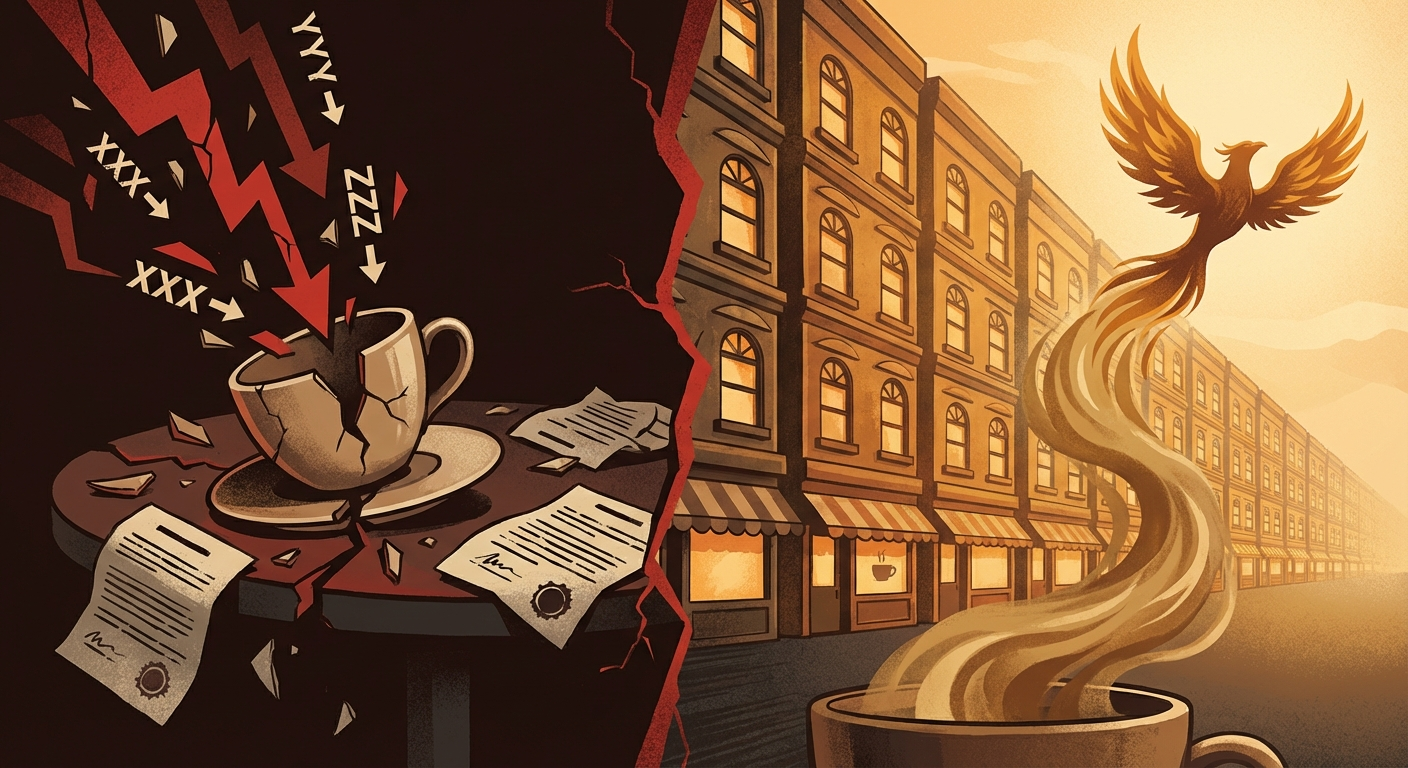
Luckin Coffee Faked $310M in Sales, Got Delisted, Then Crushed Starbucks. Here's the Decision Playbook.
A company that fabricated $310M in revenue, got delisted, and was left for dead somehow came back to run 22,340 stores and $4.7B in annual revenue — while the guy who caused the fraud launched a competitor to destroy it. This isn't a redemption arc. It's a masterclass in what happens when you stop lying and start operating.
TL;DR
- Luckin fabricated $310M in revenue, got delisted from Nasdaq, paid $180M in SEC fines — then came back to run 22,340 stores and $4.7B annual revenue by 2024.
- The turnaround wasn't PR rehab — it was operational rebuilding: vertical supply chain (own roasting plants), product innovation (coconut latte = 100M+ cups), and extreme store-level unit economics discipline.
- ⚡ The real moat isn't brand recovery — it's that Luckin now controls sourcing, roasting, and distribution at a scale competitors can't replicate quickly.
- 💬 Hidden cost: the 9.9 yuan price war with Cotti Coffee is compressing margins, and the "growth at all costs" DNA hasn't fully left the building.
- 💬 Key question: Is this a sustainable business or a subsidy-fueled volume machine that breaks when the discounts stop?
In April 2020, Luckin Coffee did something almost unheard of in corporate fraud: it turned itself in. ✓ (Source)
The company disclosed that roughly RMB 2.2 billion (~$310M) in transactions from Q2–Q3 2019 had been fabricated. ✓ (Source)
This wasn't a rounding error. It was the kind of fraud that typically ends a company — permanently.
What followed was a textbook corporate death spiral:
- Muddy Waters had published a short report months earlier, in January 2020. ✓ (Source)
- Nasdaq delisted Luckin in June 2020. ✓ (Source)
- The SEC levied a $180 million penalty, settled in December 2020. ✓ (Source)
- Chairman Lu Zhengyao, CEO Qian Zhiya, and COO Liu Jian were all removed. ✓ (Source)
- Guo Jinyi, a relatively junior SVP, was thrust into the CEO seat. ✓ (Source)
Most companies don't survive this. Luckin did — and then some.
By Q4 2024, Luckin operated 22,340 stores across China and Singapore, generated RMB 34.5 billion (~$4.7B) in annual revenue (+38.4% YoY), and had 300 million+ cumulative transaction customers. ✓ (Source)
It overtook Starbucks China in store count. It's now eyeing a Nasdaq relisting. ✓ (Source)
Fork the Status Quo doesn't do redemption stories. We do decision autopsies. What did Luckin's new management actually do — and what's the hidden cost of their playbook?
Background — How Starbucks built (and lost) the Chinese coffee throne
Before Luckin, Starbucks was the Chinese coffee market.
The playbook was elegant:
- Third space in premium locations — coffee as lifestyle, not caffeine. ✓ (Source)
- Employee culture — above-market benefits created genuine service quality. ✓ (Source)
- Product localization — sweeter, milkier drinks that Chinese consumers actually liked. ✓ (Source)
It worked beautifully. Starbucks built a self-reinforcing loop: prestige locations attracted customers, customer volume attracted landlords, landlord deals lowered costs. ⚡Inference
But there was a structural vulnerability: Starbucks sold coffee as a premium ritual in a market that was about to want coffee as a daily commodity. 💬Opinion
Two macro shifts changed everything:
- Affordability shift (平价化): Chinese consumers wanted coffee, but not at RMB 35-40/cup every day. ✓ (Source)
- Milk-coffee shift (奶咖化): The winning format wasn't espresso or pour-over — it was sweet, milky, Instagram-friendly drinks that blurred the line between coffee and milk tea. ✓ (Source)
Luckin was built to exploit both. ⚡Inference
The key decision — Luckin bet everything on "boring" operational discipline
The popular narrative says Luckin's turnaround was about marketing genius: viral collaborations, the Moutai Latte, social media buzz.
That narrative is wrong. Or at best, it's 20% of the story. 💬Opinion
The real decision was much less sexy: after the fraud, the new management team chose operational discipline over growth theater.
Here's what "boring" looked like:
1. Private domain retention — keep users without burning cash ✓ (Source)
Before the fraud, Luckin spent over RMB 10 billion in cumulative losses (2018-2020), with customer acquisition costs exceeding RMB 100/user at peak. ✓ (Source)
Post-fraud, they couldn't afford that. So they pivoted hard to WeChat-based private traffic — coupons, push notifications, community groups — to retain existing users at near-zero marginal cost. ✓ (Source)
2. Product innovation as growth engine ✓ (Source)
Between 2021 and 2024, Luckin launched 450+ new products — roughly two per week. ✓ (Source)
The hits were massive:
- Coconut Latte (生椰拿铁, 2021): "Sold out in 1 second." Single-store users jumped by 579 that quarter. ✓ (Source)
- Moutai Latte (酱香拿铁, Sep 2023): Monthly active users hit 58.5 million. Cultural phenomenon. ✓ (Source)
- Light Jasmine Milk Tea (轻轻茉莉, Aug 2024): 44 million cups in the first month, endorsed by Liu Yifei. ✓ (Source)
Each blockbuster did something advertising couldn't: it gave people a reason to walk back in. ⚡Inference
3. Stop making mistakes ⚡Inference
This sounds trivial. It isn't.
Post-fraud Luckin implemented standardized SOPs across thousands of stores — drink recipes, ingredient ratios, operating procedures — that reduced variance and made quality predictable. ✓ (Source)
When you've lost the market's trust, consistency is the first step to earning it back. 💬Opinion
4. Old shareholders injected capital ✓ (Source)
Despite the scandal, existing investors (including Centurium Capital and Joy Capital) put in fresh money, giving Luckin the runway to restructure without liquidation. ✓ (Source)
This is the part most turnaround stories gloss over: someone has to believe the corpse is still breathing. 💬Opinion
Counter-intuitive finding — The fraud architect became the biggest catalyst for Luckin's evolution
Here's where the story gets surreal.
Lu Zhengyao — the chairman who orchestrated the fraud, got expelled, and was publicly disgraced — came back and founded Cotti Coffee (库迪咖啡) in October 2022. ✓ (Source)
Cotti's strategy was a targeted missile aimed at Luckin:
- Stores deliberately placed next to Luckin locations. ✓ (Source)
- Subsidies of up to RMB 1.5 per cup for stores within 100 meters of a Luckin. ✓ (Source)
- Prices slashed to RMB 8.8, then RMB 9.9, then eventually RMB 6.9. ✓ (Source)
- 5,000 stores in 8 months. ✓ (Source)
The audacity is breathtaking. The man who nearly killed Luckin through fraud tried to finish the job through competition. 💬Opinion
And it worked — briefly. Cotti's attack forced Luckin's operating margin to halve in the quarter of impact, and eventually pushed Luckin into losses. ✓ (Source)
But here's the counter-intuitive part: Cotti's aggression forced Luckin to build the supply chain moat it otherwise might not have built. ⚡Inference
Facing a price war it didn't start, Luckin:
- Signed a 5-year, 240,000-ton direct procurement deal with Brazilian coffee farms — 3x the 2022 volume. ✓ (Source)
- Built its own roasting facilities (Fujian, Jiangsu — 45,000-ton capacity; Qingdao 55,000-ton under construction). ✓ (Source)
- Cut out intermediary traders, saving ~15% on procurement, plus another 10%+ from scale discounts. ✓ (Source)
- Dropped raw material cost ratio from 43.7% to 40.9% in 2024 — despite a 70%+ surge in global coffee bean prices. ✓ (Source)
The result: Luckin's RMB 9.9 pricing went from promotional gimmick to structurally sustainable pricing. ⚡Inference
Meanwhile, Cotti started selling breakfast noodles and lunch boxes. ✓ (Source)
The predator became the prey's personal trainer. 💬Opinion
FORKED Scorecard: Post-Crisis Turnaround
Use this when evaluating whether a company's "comeback" is real or just a dead cat bounce. Score each dimension 1-5.
Dimensions
1) Trust Rebuild — Has the fraud/crisis root cause been structurally removed (people, processes, governance)?
2) Unit Economics — Are individual stores/units profitable, not just growing top-line?
3) Competitive Moat — Is there something competitors can't easily replicate (supply chain, scale, data)?
4) Product Engine — Can the company consistently generate demand without relying on subsidies?
5) Management Quality — Are the new leaders operators, not promoters?
Luckin (2024-2025) — Indicative Scoring
- Trust Rebuild: 4/5 (Fraud team fully removed, SEC settled, pursuing relisting — but OTC stigma lingers) 💬Opinion
- Unit Economics: 3/5 (Profitable overall but single-store metrics declining; rent+ops costs growing faster than revenue) 💬Opinion
- Competitive Moat: 4/5 (Direct sourcing, own roasting, 22K store network — hard to replicate) 💬Opinion
- Product Engine: 4/5 (450+ products, multiple mega-hits — but no blockbuster in 2024, ceiling risk) 💬Opinion
- Management Quality: 4/5 (Guo Jinyi's team delivered operationally, but untested in next cycle of pressure) 💬Opinion
| Dimension | What it tests | Luckin score |
|---|---|---|
| 1 | Trust Rebuild | 4/5 |
| 2 | Unit Economics | 3/5 |
| 3 | Competitive Moat | 4/5 |
| 4 | Product Engine | 4/5 |
| 5 | Management Quality | 4/5 |
Rule: If scores 2 and 3 are both below 3, the turnaround is cosmetic. If score 4 drops below 3, the company is running on borrowed time from the last hit product. 💬Opinion
The hidden costs — What the comeback narrative doesn't tell you
1. The scale-efficiency trap
Luckin added 6,092 net new stores in 2024 — the equivalent of building an entire Chagee (霸王茶姬) in one year. ✓ (Source)
The cost:
- Rent and operating expenses hit RMB 8.54 billion, up 65% YoY — far outpacing revenue growth of 38%. ✓ (Source)
- Operating margin fell to 10.3%, down 1.8 percentage points from 2023. ✓ (Source)
- Single-store user count declined — "not enough customers to go around." ✓ (Source)
Translation: the supply chain savings from fighting Cotti were entirely consumed by the expansion costs of fighting Cotti. ⚡Inference
2. The blockbuster dependency
Luckin's growth model is addicted to hit products:
- Coconut Latte → user spike → plateau
- Moutai Latte → user spike → plateau
- No major hit in 2024 → user decline ✓ (Source)
Coffee has inherently narrower innovation space than tea — fewer fruit pairings, more constrained flavor profiles. ✓ (Source)
When your growth engine is "hope the next viral drink hits," you don't have a growth engine. You have a slot machine. 💬Opinion
3. The 45,000 dead stores nobody talks about
In 2024, approximately 45,000 coffee shops exited the Chinese market — 5x the 2023 figure. ✓ (Source)
These weren't Luckin stores. They were independent shops and smaller chains that couldn't survive the price war that Luckin and Cotti waged.
The incumbents' price war didn't just consolidate the market. It carpet-bombed it. 💬Opinion
When people celebrate Luckin's "comeback," they're also celebrating the destruction of tens of thousands of small businesses that couldn't match a supply chain built on 240,000 tons of Brazilian beans. ⚡Inference
4. The coffee bean time bomb
Global coffee bean prices surged 70%+ in 2024 due to extreme weather in Brazil and Vietnam (which together supply ~60% of global coffee). ✓ (Source)
Luckin managed to offset this through direct sourcing. But the structural risk remains: climate volatility in two countries can blow up the cost structure of an entire industry. ⚡Inference
If bean prices stay elevated and Luckin's RMB 9.9 pricing becomes unprofitable even with supply chain advantages, the whole turnaround thesis gets re-tested. ⚡Inference
The strongest counterargument — Maybe Luckin is just the new Starbucks problem
A serious bear case:
1) Revenue is growing but margins are compressing. Operating margin went from 12.1% (2023) to 10.3% (2024). ✓ If the margin trend continues, "growth" becomes "buying revenue." ⚡Inference (Source)
2) Single-store economics are deteriorating. With 22,340 stores and declining per-store users, Luckin may be past the optimal density point. ⚡Inference
3) The 9.9 yuan anchor might be permanent. Once you train 300 million customers that coffee costs less than a subway ride, raising prices becomes almost impossible. ⚡Inference That's not a turnaround — it's a pricing trap dressed as a market position. 💬Opinion
4) Cotti taught everyone the playbook. Even if Cotti itself fades, the template — aggressive franchising, below-cost pricing, targeted location strategy — is now public knowledge. ⚡Inference
Rebuttal
The counter-counter: Luckin's supply chain depth (own roasting, direct sourcing, 240K-ton Brazil deal) creates a cost floor that most competitors can't reach. ✓ (Source)
If you can profitably sell at RMB 9.9 while your competitor needs RMB 14, that's not a pricing trap — it's a structural advantage. ⚡Inference
The question is whether "structural advantage" at 10% margins leaves enough room for the next crisis. 💬Opinion
What Would You Do?
You're Guo Jinyi in early 2026.
You've pulled off the corporate comeback of the decade. You have 22,340 stores, $4.7B revenue, and a Nasdaq relisting on the horizon.
But:
- Your operating margin is compressing.
- You haven't had a blockbuster product since the Moutai Latte.
- Coffee bean prices are volatile.
- Starbucks is cutting prices.
- 45,000 competitors died last year — and people are starting to notice the carnage.
Do you:
- Keep expanding and bet on supply chain scale to win the war of attrition?
- Slow down, optimize per-store economics, and accept lower top-line growth?
- Diversify into tea (the Jasmine Milk Tea play) and become a general beverage platform?
- Push for the Nasdaq relisting and use the capital event to reset the narrative?
There's no victory lap. There's only the next quarter.
Forked question: When does a turnaround become the new status quo — and when does the status quo start looking fragile again? 💬Opinion
FAQ
Q: How much did Luckin Coffee fake in revenue?
✓ Luckin fabricated roughly RMB 2.2 billion (~$310M) in transactions from Q2–Q3 2019. (Source)
Q: What penalty did Luckin receive?
✓ The SEC levied a $180 million penalty, settled in December 2020. (Source)
Q: How big is Luckin today?
✓ By Q4 2024, Luckin operated 22,340 stores, generated RMB 34.5B (~$4.7B) in annual revenue (+38.4% YoY), with 300M+ cumulative transaction customers. (Source)
Q: Who led the turnaround?
✓ Guo Jinyi, a relatively junior SVP, was thrust into the CEO seat after the original leadership was removed. (Source)
Q: What is Cotti Coffee?
⚡ Cotti was founded by Lu Zhengyao—the same person behind Luckin's fraud—as a direct competitor to destroy Luckin. It aggressively undercut pricing with 9.9 yuan cups.
Q: Did Luckin beat Starbucks in China?
✓ By store count and transaction volume, Luckin surpassed Starbucks China. But revenue per store and brand positioning differ significantly.
Q: Is Luckin relisting on Nasdaq?
✓ As of late 2024, Luckin was actively pursuing a Nasdaq relisting. (Source)
Q: What's the key decision lesson from Luckin's turnaround?
💬 A turnaround isn't about PR or hustle—it's about building operational moats (direct sourcing, own roasting, vertical control) that competitors can't copy fast enough.
📩 Want more decision frameworks? Subscribe to the FORKED newsletter — one CEO decision breakdown per week, zero fluff.
💬 Related reads:
- DuPont CEO Spent ~$20B to Escape Oil
- Canva's Melanie Perkins: 100 No's
- Shopify's 5 Pivot Decisions
- Phrozen Founders Part 2: From $35M to $24M and Back
Sources (URLs)
- https://www.xiaoyuzhoufm.com/episode/646ddf0f6752b5f9de01031d
- https://www.sec.gov/newsroom/press-releases/2020-319
- https://www.scmp.com/business/companies/article/3114281/luckin-coffee-pay-us180-million-settle-sec-charges-accounting
- https://www.cnbc.com/2025/11/12/luckin-coffee-us-nasdaq-relisting-five-year-turnaround-fraud-scandal-starbucks-jinyi-guo-xiamen.html
- https://finance.sina.com.cn/tech/csj/2025-02-21/doc-inemeuym3093716.shtml
- https://finance.sina.com.cn/tech/roll/2025-02-21/doc-inemffqf2895182.shtml
- https://investor.luckincoffee.com/news-releases/news-release-details/luckin-coffee-announces-fourth-quarter-and-fiscal-year-2024
- https://www.nasdaq.com/press-release/luckin-coffee-announces-fourth-quarter-and-fiscal-year-2024-financial-results-2025-02
- https://36kr.com/p/3204668458443272
- https://www.cbndata.com/information/213038
- https://en.wikipedia.org/wiki/Luckin_Coffee
- https://www.mordorintelligence.com/industry-reports/china-coffee-market
- https://www.businessweekly.com.tw/international/blog/3018696
- https://finance.sina.com.cn/roll/2024-09-03/doc-incmvqpu0515302.shtml
🔀 What Would You Do?
You take over a company that just got caught faking $310M in revenue, lost its Nasdaq listing, and the founder is launching a copycat to kill you. What do you do first?
🔀 One CEO decision, dissected weekly
No fluff. No hero worship. Just frameworks, data, and a decision model you can steal.
Unsubscribe anytime. We don't sell your data.
Disclaimer
This article was researched and written with AI assistance by the FORKED editorial team, with human review. Markers: ✓ = verified fact, ⚡ = reasoned inference, 💬 = editorial opinion. While we strive for accuracy, information may contain gaps or errors. This is not investment, legal, or business advice.
All analysis is based on publicly available information. If you spot a factual error or have copyright concerns, please use the report button below or contact us.