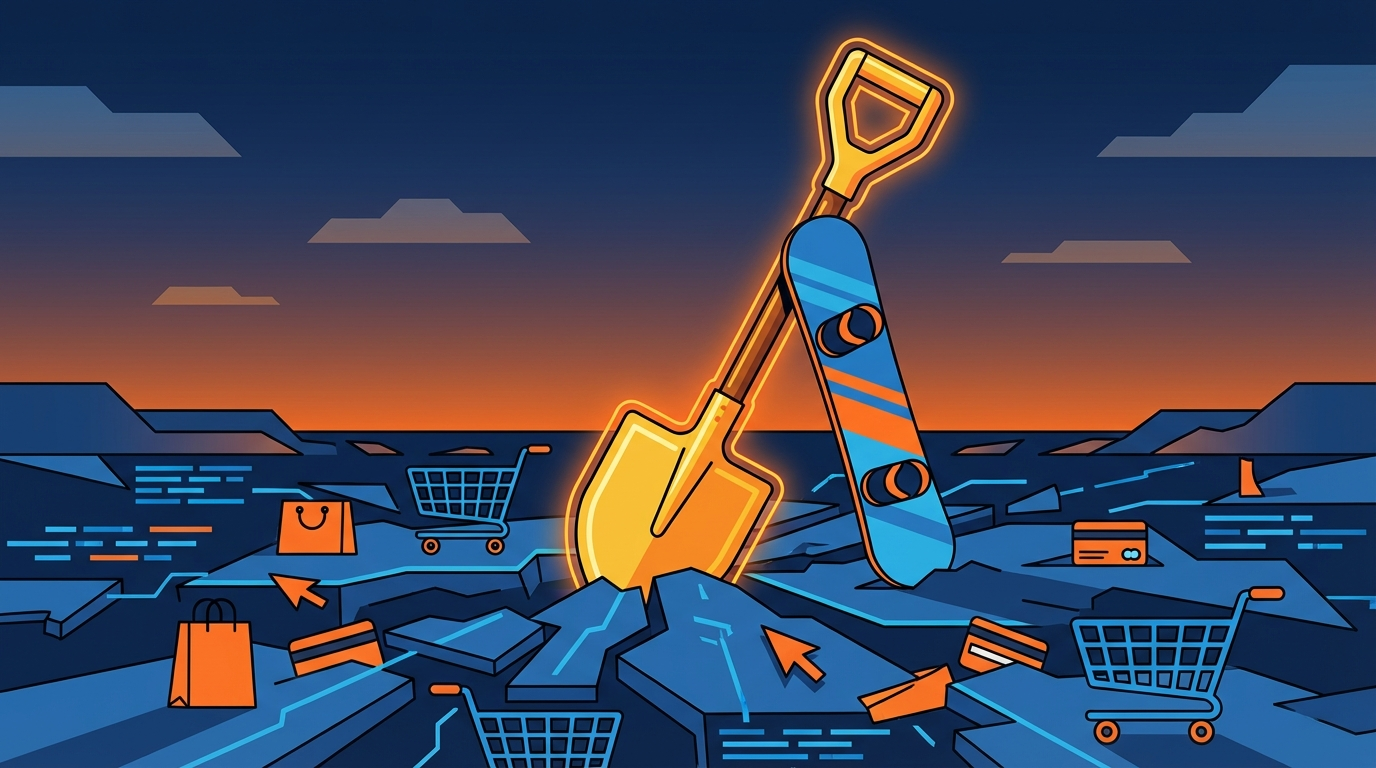
From Snowboards to $292B: Shopify's 5 Pivot Decisions (With a Scorecard You Can Steal)
Shopify didn't start as a startup. It started as a snowboard shop called Snowdevil. Here are the 5 pivot decisions that turned an engineer's frustration into a $292B commerce platform—plus a scorecard you can steal to evaluate your own pivot.
TL;DR
- Shopify started as a snowboard shop (Snowdevil) — Tobi Lütke pivoted not away from pain, but toward the pain that scaled: merchant infrastructure.
- Five key decisions turned a side project into a $292B platform powering 12% of US e-commerce: open API, app ecosystem, Shopify Payments, and global expansion.
- ⚡ Shopify won by being a constraint remover, not a feature factory — solving the problems merchants didn't know they had.
- 💬 Hidden cost: years of near-zero revenue, co-founder dilution, and the constant temptation to stay in the "comfortable" snowboard business.
- Use the FORKED Scorecard: Pivot Scoring to evaluate whether your pivot has real signal or just founder restlessness.
From Snowboards to $292B: Shopify's 5 Pivot Decisions
Shopify didn't pivot from failure. It pivoted from a working snowboard shop called Snowdevil—because the tooling behind it was obviously the bigger opportunity. Here are the 5 decisions that made it a $292B commerce platform.
Hook: the Shopify pivot wasn't "idea → startup," it was "pain → infrastructure"
💬 Shopify didn't start as a startup in the way founders tell the story at conferences.
✓ It started as a snowboard shop project ("Snowdevil") built by Tobias Lütke and co-founders in Ottawa in the mid-2000s. (Source)
⚡ The origin isn't "Tobi built software," it's "Tobi chose a kind of pain worth repeating—then built a business around repeating it."
💬 Most pivots fail because founders pivot away from pain; Shopify pivoted toward the pain that scaled.
Background (2004–2006): Snowdevil exposed the real product
✓ Tobias "Tobi" Lütke used Ruby on Rails to build the Snowdevil online store and launched it after roughly two months of development. (Source)
⚡ The technical detail matters because it shows the "seed" wasn't e-commerce—it was an engineer's intolerance for clunky tools.
💬 Great pivots often start as a refusal to accept the defaults everyone else tolerates.
✓ Shopify was launched as a platform in June 2006. (Source)
⚡ By the time "Shopify" existed, the snowboard shop had already done its job: it generated a real-world test suite of merchant problems.
💬 The store wasn't the business; it was the lab.
⚡ Accounts of Shopify's early launch mention a pre-launch email list in the low thousands (often cited as ~4,000–5,000). (Source)
💬 Even if that number is off, the strategic point stands: Shopify treated distribution as a first-class product requirement, not a marketing afterthought.
The Shopify pivot decisions (and the "other path" that fails)
Decision 1: Refuse "good enough" e-commerce tools—build your own backend
✓ Shopify's founders built their own e-commerce software after finding existing options (Yahoo Stores, Miva, osCommerce) too limiting for what they wanted to do. (Source)
⚡ This is a classic "scratch your own itch" moment, but the non-obvious part is which itch: not "sell snowboards," but "control the commerce workflow end-to-end."
💬 The first pivot was internal: from "merchant mindset" to "platform mindset."
The other path: keep using off-the-shelf storefront tools and focus on retail execution.
⚡ That path likely fails because the constraint becomes permanent: every growth idea must pass through someone else's rigid template system.
💬 You don't just lose features—you lose iteration speed, which is the only real unfair advantage a small team has.
Decision 2: Treat "Can I buy your system?" as a pull signal, not a compliment
⚡ Merchants asking to buy the system is the cleanest form of early demand: it's not a survey, it's a request to transact.
💬 Most founders hear that question and feel validated; Shopify heard it and felt obligated.
The other path: ignore the requests and keep the software as an internal advantage.
⚡ That path likely fails because "internal tools" rarely get the sustained investment needed to become excellent; they get patched until they stop bleeding, then neglected.
💬 The moment you decide it's "just internal," you cap the quality ceiling.
Decision 3: Choose a bigger market over the original identity (shop → platform)
✓ Shopify's 2024 GMV was about $292.28B. (Source)
⚡ You don't get to that scale by being a great snowboard store; you get there by becoming commerce infrastructure.
The other path: stay Snowdevil, become "the best snowboard shop on the internet."
⚡ That path likely fails to create venture-scale outcomes because retail margins + inventory risk + seasonality + platform competition compress upside.
💬 You can be excellent and still be trapped in a business model that punishes excellence.
Decision 4: Build distribution before the "real" launch
✓ In 2024, Shopify crossed $1T in cumulative GMV. (Source)
⚡ That kind of compounding outcome typically requires an engine that starts before the product feels "ready."
💬 Distribution is not what you do after product; distribution is what tells you what product must be.
The other path: "perfect it first," then launch with a press release.
⚡ That path fails because the internet doesn't reward readiness; it rewards momentum and stories carried by people who already trust you.
💬 A quiet launch isn't humble—it's often avoidance dressed up as craftsmanship.
Decision 5: Stay technical as CEO (and keep the product loop tight)
✓ Shopify President Harley Finkelstein said "in the U.S. alone, Shopify is now over 12% of the ecommerce market share." (Source)
⚡ Depending on how "e-commerce market share" is defined, you can reasonably interpret that as roughly a ~10–14% band.
💬 When your company becomes a slice of national commerce, leadership mistakes stop being "startup mistakes" and start becoming systemic risk. (Brian Chesky made a similar bet at Airbnb—see Founder Mode Isn't 'Micromanagement with Swagger'.)
The other path: hire a "professional CEO," move the founder into a ceremonial product role.
⚡ That path often fails in developer-heavy infrastructure businesses because decision latency becomes the silent killer.
💬 You don't lose because you lack talent—you lose because you can't decide.
What "technical CEO" actually buys you:
⚡ Compresses the distance between a user's pain and the company's response by removing translation layers.
⚡ Spots "architecture debt" early, when it's still a choice rather than a catastrophe.
⚡ Demands a higher bar for internal tooling, deployment safety, and iteration speed.
💬 The real advantage isn't coding; it's refusing to let the company become illiterate in its own machinery.
The cost:
⚡ Staying technical at the top is expensive because it forces you to keep learning while your calendar tries to make you obsolete.
💬 The CEO role pushes you toward performance; technical leadership pushes you toward truth, and truth is slower and more confrontational.
The counter-intuitive insight: Shopify won by being a "constraint remover"
💬 Shopify didn't win by being the prettiest store builder; it won by removing the constraints that made commerce feel like punishment.
Concrete constraints Shopify removed:
⚡ Time-to-launch: making "open a store" closer to hours/days than weeks/months.
⚡ Payment acceptance: reducing the operational work to take and reconcile payments.
⚡ Checkout conversion: improving the default path to purchase so merchants don't need to be conversion experts.
⚡ Integration: enabling an ecosystem of apps so merchants can add capabilities without rewriting their store.
⚡ Operational complexity: centralizing core admin workflows so "running the business" isn't a spreadsheet circus.
💬 The meta-lesson: people don't pay for your vision—they pay for the constraints you delete from their week.
Counterfactual: What if Snowdevil never pivoted?
Outcome 1: Solid niche retailer
⚡ Respected brand, comfortable business—but capped upside tied to inventory, seasonality, and marketplace competition.
💬 That's not failure, but it's a ceiling.
Outcome 2: The internal software slowly rots
⚡ Without external customers, the software becomes a patchwork optimized for one store's quirks.
💬 Internal tools rarely become generational platforms because no one is paying you to make them general.
Outcome 3: A competitor builds the platform—and you become their customer
⚡ The market demand for easier e-commerce was real; if Snowdevil didn't pivot, someone else still would.
💬 The saddest counterfactual: you end up buying the future you could have built.
FORKED Scorecard: Pivot Scoring
How to use this scorecard 💬 Pick a business decision you're currently facing. Score it on each criterion below (1–5). Add up your total, then check the interpretation bands.
⚡ Scoring tip: Be honest. If you catch yourself giving a 4 "because it feels about right," ask: what specific evidence supports this score? No evidence = score it a 2.
How to interpret your total ⚡ 24–30 = Rational pivot. The market is already dragging you; you're simply agreeing to be pulled. ⚡ 18–23 = Test harder. Pilot, pre-sell, or narrow the wedge before committing. Re-score in 30 days with new data. ⚡ ≤17 = Don't pivot. You might be fleeing discomfort, not pursuing leverage. Fix what's broken first.
| Criterion | What to ask | 5 = | 1 = | Shopify |
|---|---|---|---|---|
| Pain Intensity | Is this problem daily, expensive, emotional? | Every merchant, every day, willing to pay | Only you, occasionally, low stakes | 5 |
| Founder Advantage | Can you solve it better than anyone else right now? | Built working system, domain expertise | Just an idea, no prototype | 5 |
| Market Expansion | Does the pivot unlock 10x+ market? | Snowboards → all merchants globally | Same niche, same ceiling | 5 |
| Pull Signals | Are people asking to buy unprompted? | Paying inquiries, repeat requests | "Sounds cool" but no wallet | 4 |
| Distribution Ready | Can you reach early users fast? | Pre-launch list, community, partners | No audience, no channel | 4 |
| Moat Potential | Does it compound with scale? | Network effects, ecosystem lock-in | Commodity, easily copied | 5 |
When to re-score 💬 Re-evaluate every 30–90 days or after a major market signal. If your total drops below 18, it's not a failure—it's data telling you to adjust course.
Kill Criteria (when NOT to pivot, even with high scores) 💬 High scores don't guarantee success. Stop if: ⚡ You have zero external validation (no one has paid or committed to pay). ⚡ Your core business cash flow is deteriorating and the pivot will accelerate the bleed. ⚡ You'd be competing head-on with an entrenched incumbent with no distribution advantage. ⚡ Every deal requires heavy customization (you're building a service, not a product). ⚡ Your team can't maintain a product long-term (only sprint-and-ship culture).
Hidden Costs (what Tobi paid that nobody talks about)
1. Product identity → responsibility identity
⚡ A snowboard shop can be quirky; a commerce platform can't afford downtime.
💬 Uncomfortable truth: the day you become infrastructure, you lose the right to move fast and break things.
2. You inherit everyone else's edge cases
⚡ One catalog becomes millions of brands, tax rules, fraud patterns, shipping quirks.
💬 Uncomfortable truth: your "simple product" becomes a permanent negotiation with every government and payment network on Earth.
3. You become the target of politics
⚡ Platforms scale controversy alongside revenue.
💬 Uncomfortable truth: you'll be pressured by merchants, regulators, activists, and competitors simultaneously—and "we're just a tool" stops working as a defense.
4. CEO compensation distorts the narrative
✓ Tobi Lütke's 2024 total compensation was reported at $205.5M (largely stock/options). (Source)
💬 Uncomfortable truth: once the number goes public, people stop seeing the 18-year grind and start seeing a target.
5. Staying technical is lonely
⚡ Every hour in code is an hour not doing politics, fundraising, or narrative management.
💬 Uncomfortable truth: the market rewards CEOs who perform confidence, not CEOs who debug production at 2am. (See also: James Dyson Bet £500M on an EV—Then Killed It for another CEO who chose conviction over optics.)
What Would You Do?
💬 If your first product works well enough—but the tooling behind it is obviously the bigger opportunity—do you have the courage to abandon the original identity?
⚡ Action: List 3 things people have asked to buy from you in the last 90 days. Score each on the scorecard above. If any scores ≥24, you owe yourself a serious conversation about whether you're sitting on a platform.
📩 Want more decision frameworks like this scorecard? Subscribe to the FORKED newsletter — one CEO decision breakdown per week, zero fluff.
💬 Next article: "The Most Common Suicide Move in a Pivot: Confusing 'Productization' with 'Adding Features'"
💬 Related reads:
- Canva's Melanie Perkins: The Decision Discipline Behind 100 No's
- DuPont CEO Spent ~$20B to Escape Oil
- Luckin Coffee Faked $310M, Got Delisted, Then Crushed Starbucks
- A $5K Order Came Back Unopened: 5 Packaging Failures That Forged Phrozen's Resin 3D Printer Playbook
- Toyoda's $38B Anti-EV Bet: Why Toyota's Chairman Chose Patience Over Panic
FAQ
Q: What did Shopify pivot from?
✓ Shopify started as Snowdevil, an online snowboard shop founded in 2004 in Ottawa, Canada. The founders pivoted to selling the e-commerce software they built to run their own store. (Source)
Q: When did Shopify launch as a platform?
✓ Shopify launched as a platform in June 2006, after roughly two years of building and operating Snowdevil. (Source)
Q: Why did Shopify build its own platform instead of using existing tools?
✓ The available options (Yahoo Stores, Miva, osCommerce) were too rigid and limiting for the founders' needs, so Tobi Lütke built a custom solution with Ruby on Rails. (Source)
Q: How big is Shopify today?
✓ In FY2024, Shopify reported $8.88B in revenue (+26% YoY) and $292.3B in GMV. Cumulative GMV has crossed $1 trillion. (Source)
Q: Is Tobi Lütke still CEO?
✓ Yes. Tobi has been CEO since 2008 and is known for remaining deeply involved in product and engineering decisions. (Source)
Q: What was Shopify's original tech stack?
✓ Tobi Lütke built Shopify using Ruby on Rails and has been a prominent advocate for the framework. The choice of Rails enabled rapid iteration during the critical early years. (Source)
Q: How does Shopify compare to Amazon for merchants?
⚡ Amazon owns the customer relationship; Shopify gives the merchant full ownership of branding, customer data, and checkout experience. The trade-off is traffic: Amazon brings buyers, Shopify requires you to bring your own. (Source)
Q: What is the Shopify App Store?
✓ Shopify's app ecosystem allows third-party developers to build and sell extensions, creating a marketplace with thousands of apps covering inventory, marketing, analytics, shipping, and more. This ecosystem is a key competitive moat. (Source)
Sources - Digital Commerce 360 — Shopify FY2024 results: https://www.digitalcommerce360.com/2025/02/12/shopify-revenue-gmv-q4-fy24/ - Toronto CityNews / CCPA — CEO compensation: https://toronto.citynews.ca/2026/01/02/canadas-highest-paid-ceos-made-an-average-of-16-2-million-in-2024-report/ - Marketplace Pulse — US e-commerce share: https://www.marketplacepulse.com/articles/amazon-and-shopify-are-now-half-of-us-e-commerce - Wikipedia — Shopify history: https://en.wikipedia.org/wiki/Shopify - Founderoo — Pre-launch email list: https://www.founderoo.co/playbooks/tobi-lutke-shopify - Quartr — Tobi Lütke profile: https://quartr.com/insights/business-philosophy/tobi-luetke-from-passionate-coder-and-snowboarder-to-shopify-ceo
🔀 What Would You Do?
Would you pivot away from a working product to chase a bigger platform opportunity?
🔀 One CEO decision, dissected weekly
No fluff. No hero worship. Just frameworks, data, and a decision model you can steal.
Unsubscribe anytime. We don't sell your data.
Disclaimer
This article was researched and written with AI assistance by the FORKED editorial team, with human review. Markers: ✓ = verified fact, ⚡ = reasoned inference, 💬 = editorial opinion. While we strive for accuracy, information may contain gaps or errors. This is not investment, legal, or business advice.
All analysis is based on publicly available information. If you spot a factual error or have copyright concerns, please use the report button below or contact us.